

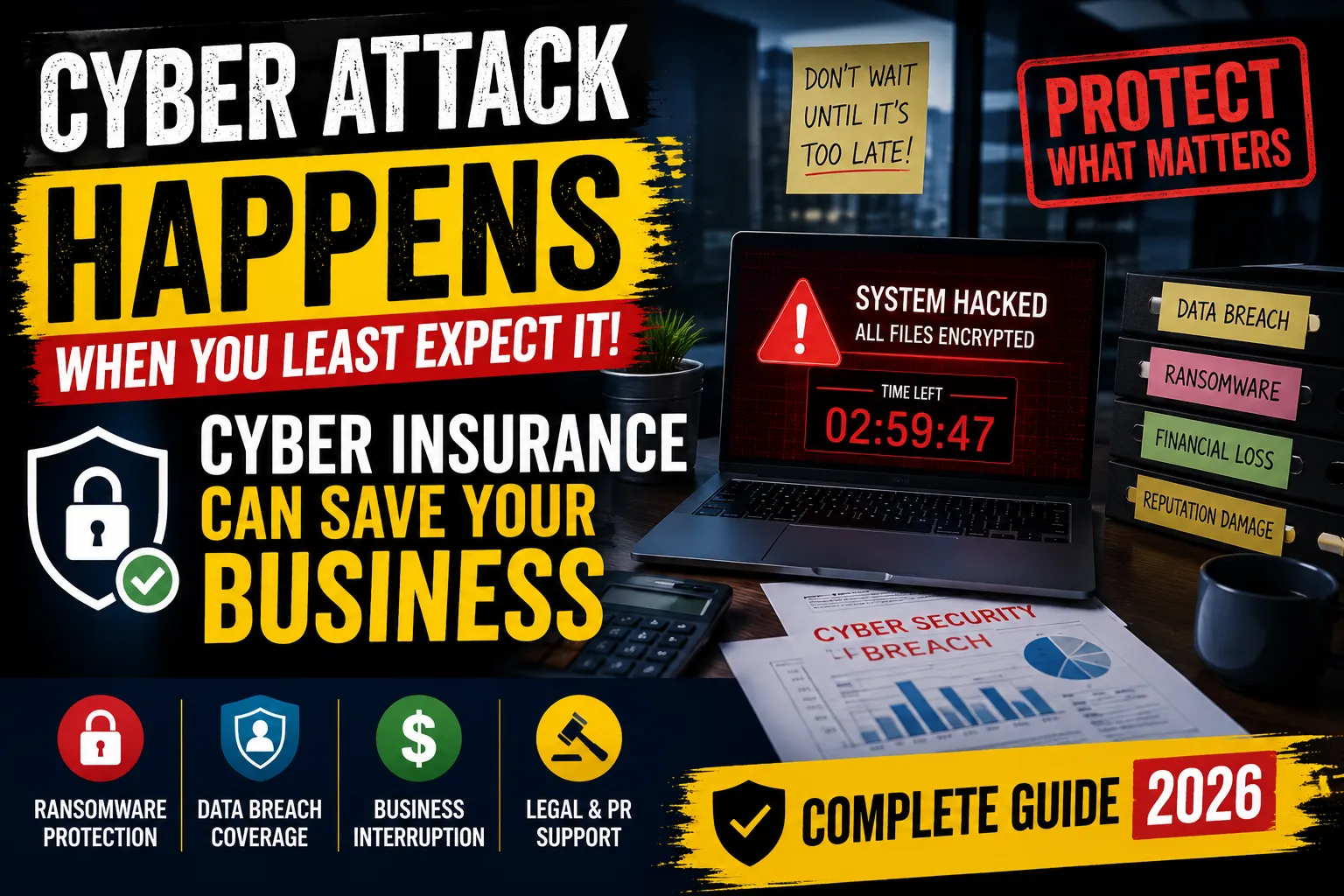
A few years ago, cyber insurance was one of those things small business owners nodded along to at industry events and then quietly forgot about. It felt like coverage for banks and hospitals, not for a five-person marketing agency or a family-owned HVAC company.
That’s changed. Fast.
Ransomware gangs don’t care how big your company is — smaller businesses are often easier targets precisely because they have thinner security budgets. And the numbers back this up: small and mid-sized companies now account for the overwhelming majority of cyber insurance claims by volume, even though the biggest, most expensive breaches still happen at large enterprises. In other words, you’re less likely to get hit for millions, but you’re more likely to get hit, period.
So let’s walk through what cyber insurance actually is, what it costs, what it covers, and how to tell if your business genuinely needs it — without the sales pitch.

What Cyber Insurance Actually Does
Think of cyber insurance the way you’d think of a fire extinguisher. It doesn’t stop the fire from starting. It’s there so the fire doesn’t take the whole building down with it.
A typical policy is split into two buckets:
First-party coverage — this pays for the mess you have to clean up yourself. Think forensic investigators to figure out what happened, credit monitoring for customers whose data leaked, the cost of notifying everyone by law, lost income while your systems are down, and increasingly, the ransom payment itself if you’re hit with ransomware.
Third-party coverage — this kicks in when someone sues you because your breach affected them. A client whose payment info got stolen. A vendor whose network got infected because of you. Legal defense, settlements, regulatory fines where insurable — this is the bucket that covers those.
Some policies also include something called “dependent business interruption,” which matters more than most owners realize. If your business runs on Microsoft 365, AWS, or some other cloud vendor, and that vendor goes down, you can lose real money even though the breach wasn’t technically yours. Good policies account for that. Cheap ones often don’t.
What It Actually Costs
Here’s where a lot of the confusion comes from — you’ll see wildly different numbers depending on where you look, and both can be technically correct.
For a straightforward small business — say, under 50 employees, no massive trove of sensitive data — a standalone policy with a $1 million limit generally runs somewhere between $1,000 and $3,000 a year. Some brokers quote closer to $1,500 as a starting point for a clean risk. Businesses that handle a lot of regulated data (healthcare, financial services, legal) tend to land on the higher end of that range, sometimes $2,500 to $5,000, simply because a breach involving medical or financial records triggers more notification requirements and more expensive cleanup.
A few things move that number more than anything else:
- Industry. Tech and IT companies pay well above average because they’re handling more digital exposure by nature of the work. Recreation and low-transaction businesses pay noticeably less.
- Company size. Somewhat counterintuitively, the jump from a solo operation to a 20–49 person company can more than triple your premium — more employees means more logins, more devices, more ways in.
- Your actual security posture. This is the one you control. Multi-factor authentication, offline backups, and an incident response plan aren’t just “best practices” anymore — insurers ask about them directly, and having them in place is one of the few real levers you have to lower your rate.
Premiums dipped for a couple of years after the market tightened post-pandemic, but the trend for this year is upward again, as ransomware payouts climb and insurers recalibrate. If you’ve been putting off getting a quote because you assumed it’d be too expensive, it’s worth revisiting — pricing has actually been more favorable for well-prepared businesses lately than a lot of owners expect.
The Part Nobody Warns You About: Claim Denials
This is the uncomfortable truth about cyber insurance. A meaningful share of insured businesses that file a claim get some or all of it denied — often because of something buried in the application, not the incident itself.
The most common reason: the business answered a security questionnaire optimistically rather than accurately. Said they had multi-factor authentication enabled everywhere when really it was only on a couple of accounts. Said backups were tested regularly when nobody had actually checked in over a year. Insurers increasingly treat these as material misrepresentations, and if it comes out during a claim investigation, that’s grounds to deny the whole thing.
The fix here isn’t complicated, it’s just tedious: answer the application honestly, even if it means a slightly higher premium or a follow-up call from the underwriter. A policy that pays out on a $2,000 premium beats a cheaper one that doesn’t pay out at all.
Do You Actually Need It?
Not every business needs the same coverage, but very few small businesses today are genuinely low-risk. Ask yourself a few honest questions:
- Do you store customer payment information, health records, or personal data of any kind?
- Would your business survive three to five days with no computer or network access?
- Do you rely on cloud tools that, if they went down, would stop you from serving customers?
- Have you ever had an employee click a phishing link, even one that didn’t lead to anything serious?
If you answered yes to more than one of those, you’re not a hypothetical target — you’re a normal small business in 2026, and that’s exactly the profile insurers are pricing coverage for. The average cost of a data breach globally sits in the millions once you add up investigation, downtime, legal exposure, and reputational damage. Very few small businesses have that kind of cash sitting around as a rainy-day fund.
A Few Practical Notes Before You Buy
Don’t just take the cheapest quote. A $500 difference in premium is meaningless if the cheaper policy has a sublimit on ransomware payments or excludes social engineering fraud, which is currently one of the most common and expensive claim types out there — the kind where an employee wires money to a fraudster impersonating a vendor.
Ask specifically about business email compromise coverage. This is one of the most frequent claims small businesses actually file, and it’s also one of the easiest to accidentally leave uncovered or underinsured.
Get quotes from more than one carrier. Coverage details vary more between insurers than most people expect — two “$1 million cyber policies” can look nothing alike once you read the exclusions.
Treat it as part of your security budget, not separate from it. The businesses getting the best rates aren’t the ones with the biggest IT departments — they’re the ones that can check the boxes insurers actually ask about: MFA, offline backups, an incident response plan, and basic employee phishing training.
The Bottom Line
Cyber insurance isn’t going to stop someone from targeting your business, and it won’t fix a bad security setup. What it does is make sure that if the worst happens — and for small businesses, the odds of “if” have quietly become “when” — you’re not paying six figures out of your own pocket to survive it.
If you haven’t looked at a policy in the last year or two, it’s worth getting a fresh quote. Pricing, coverage terms, and insurer requirements have all shifted enough recently that an old comparison probably doesn’t reflect what’s available to you now.
Frequently Asked Questions
Is cyber insurance required by law for small businesses?
No federal law mandates cyber insurance for small businesses. That said, some states and industries effectively require it through the back door — if you handle healthcare data (HIPAA), payment cards (PCI-DSS), or work with clients who require proof of coverage in their contracts, you may need a policy to stay compliant or even to win the business in the first place.
Does general liability insurance cover cyber attacks?
Generally, no. Standard general liability policies are built around bodily injury and physical property damage, and most now explicitly exclude cyber-related losses. That’s exactly why standalone cyber liability insurance exists — it fills a gap your existing policy almost certainly doesn’t cover.
How much does small business cyber insurance cost?
Most small businesses pay somewhere between $1,000 and $3,000 a year for a $1 million policy, though it can run as low as $500 for a very low-risk sole proprietor or climb past $5,000 for businesses handling regulated data like health or financial records. Your industry, employee count, and security controls all move that number more than anything else.
What does cyber insurance not cover?
Most policies won’t cover losses from known, unpatched vulnerabilities you failed to fix, intentional acts by you or an owner, or reputational damage in the abstract sense (as opposed to the direct costs of managing it). Many policies also cap or exclude social engineering fraud unless you specifically add that coverage — worth double-checking before you sign.
Is ransomware insurance the same as cyber insurance?
Not exactly — ransomware coverage is typically one component inside a broader cyber insurance policy, not a separate product. It usually covers the ransom payment itself (where legally permitted) plus negotiation and data recovery costs, but check your policy’s sublimits, since some cap ransomware payouts lower than the overall policy limit.
What are insurers’ cyber insurance requirements in 2026?
Underwriters are increasingly strict about baseline controls before they’ll even quote you: multi-factor authentication on email and remote access, offline or immutable backups, and some form of employee phishing training. Answer these honestly on your application — overstating your security posture is one of the most common reasons claims get denied later.

